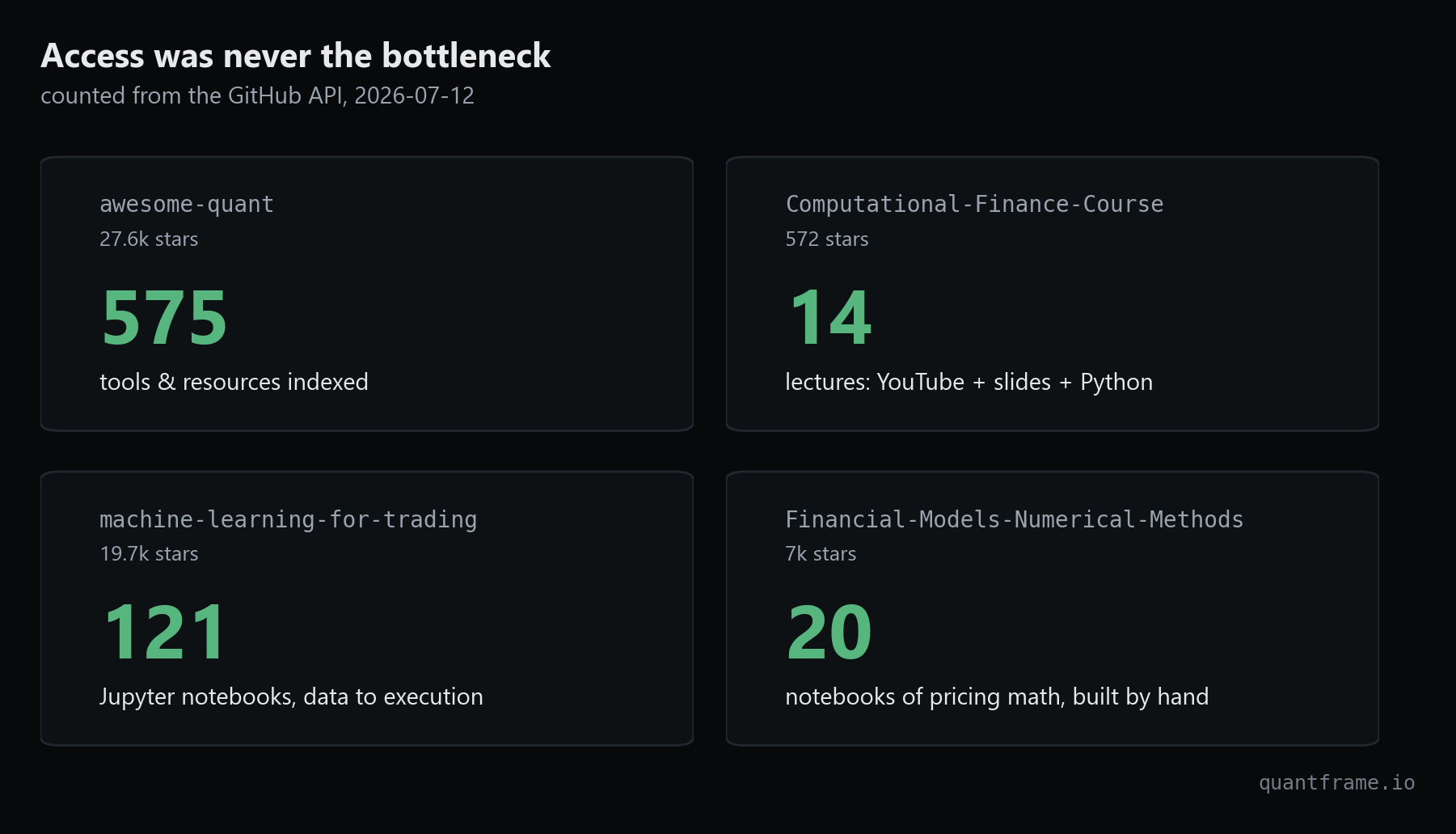
Everything you need to learn quantitative finance is sitting on GitHub, free. I counted it this week: an index of 575 quant tools and libraries, a complete 14-lecture graduate course on derivatives pricing, 121 notebooks that walk from raw market data to a live trading strategy, and 20 more that make you build the pricing models yourself. The four repositories holding all of this carry about 55,000 stars between them.
If this link landed in your DMs, you asked for the repos. You are getting them, plus the part that does not fit in a carousel.
None of this is hidden. Most of it has been public for years. So the real question is not where to find resources. The real question is why, if a full quant education is free, everyone who starts it does not end up a quant.
Here are the four, in the order I would use them, with an honest note on how hard each one actually is. After that, I will show you why a folder of bookmarks so rarely turns into a skill.
Counted from the GitHub API on the day I wrote this. Supply is not the problem.
awesome-quant calls itself "a curated list of insanely awesome libraries, packages and resources for Quants", and for once a README undersells nothing. When I parsed it on July 12, it linked out to 575 tools and resources across 19 sections: numerical libraries, pricing engines, backtesting frameworks, portfolio optimization, factor analysis, alternative data, market data sources, time series tools and more. Python dominates, but R, Julia, C++ and several other languages are covered. It sits at about 27,600 stars and is still actively maintained; recent additions include the current wave of LLM and agent-based trading tools.
This is the best single bookmark in quant finance. Six months from now, when you need a backtesting engine or a portfolio optimizer, this list turns five hours of googling into five minutes of choosing.
Just be clear about what it is not. It is not a course, there is no order, and nothing in it will ever check whether you learned anything. Browsing costs nothing, but actually using anything on the list assumes you already write decent Python. Bookmark it on day one, use it for the next decade, and do not confuse collecting tools with learning them.
Grzelak Put a Graduate Derivatives Course on YouTube
Lech Grzelak co-wrote the textbook "Mathematical Modeling and Computation in Finance" with Cornelis Oosterlee, and then he did something rare for a textbook author: he put the entire course online for free. Fourteen lectures, each with a full video on his YouTube channel, PDF slides and working Python code. The repo holds 15 PDFs and 31 Python files; I checked the file tree so you do not have to.
The syllabus is a real graduate syllabus, not a YouTube version of one: option pricing and simulation, implied volatility, jump processes, affine jump diffusions, stochastic volatility, Fourier-based pricing, Monte Carlo methods for the Heston model, hedging and Monte Carlo Greeks, forward-start options, the Bates model, exotic derivatives.
That list is also your difficulty warning. A few lectures in, you are expected to read models like Heston without flinching:
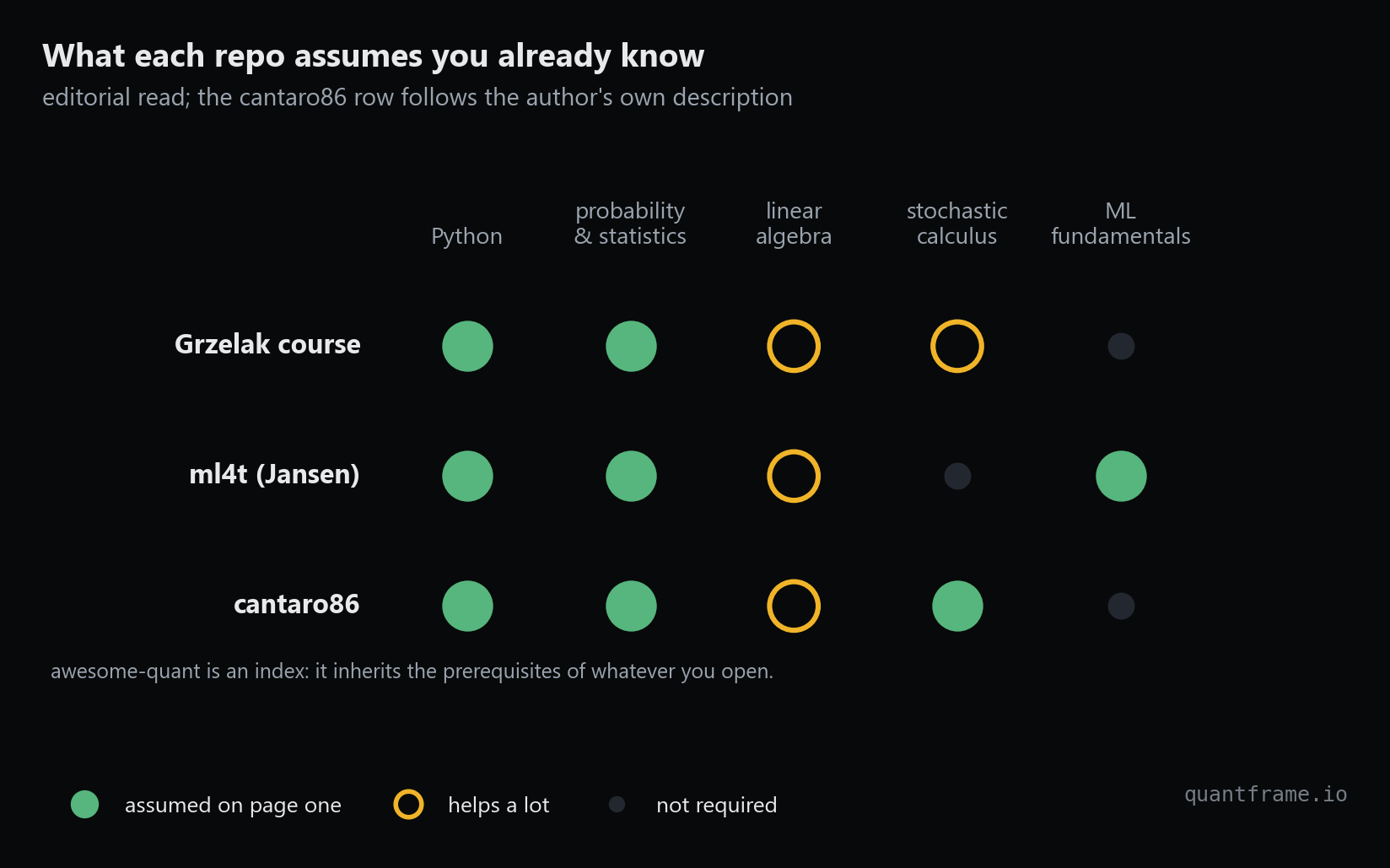
If that notation reads like a sentence, this course is one of the best free gifts on the internet. If it reads like a wall, that says nothing about your ceiling; it just means this is not your week one. Before opening it you want comfortable Python, solid probability and statistics, and at least a first pass at stochastic calculus. In a sane learning path this is your derivatives pillar several months in, not your starting point.
Stefan Jansen Wrote the Book on ML for Trading, and the Code Is Free
This is the companion code to "Machine Learning for Trading", now in its third edition, and it is the closest thing GitHub has to a complete applied quant curriculum: 121 Jupyter notebooks across 27 chapters, with nine case studies running through the whole arc. It starts at market, fundamental and alternative data, moves through alpha factor research and feature engineering, covers linear models, gradient boosting and deep learning, and lands on backtesting, portfolio construction and execution. The third edition even reaches into the current era, with material on RAG, knowledge graphs and agentic workflows. It has about 19,700 stars, and the last push was the day before I wrote this.
Here is the honest catch. The book teaches machine learning for trading. It does not teach machine learning, and it does not teach Python. The repo itself ships 112 separate "primer" notebooks explaining background concepts the main text relies on, which tells you exactly how much background the main text assumes. If pandas still fights you, or train-test leakage is not yet a reflex, the 121 notebooks will happily run top to bottom while teaching you very little.
Before opening it: real Python including pandas, ML fundamentals, and enough statistics to smell a suspicious backtest. Where it fits: after your foundations, when you are ready to learn how alpha research is actually structured.
Nicola Cantarutti's collection of 20 interactive notebooks is the odd one out on this list, and per hour spent it might be the most valuable. Everywhere else you call a pricing function. Here you build it: Black-Scholes solved numerically several different ways, stochastic differential equation simulation, Fourier inversion, the Merton jump-diffusion model through its PIDE, Variance Gamma, the Heston model, volatility smile calibration, the Kalman filter, Ornstein-Uhlenbeck processes, American options.
Real model intuition comes from exactly this. You stop treating Heston as a magic black box the day you discretize it yourself and watch what breaks.
Cantarutti is refreshingly honest about his audience. He describes the collection as "almost" a tutorial, written for readers who already have foundations in stochastic calculus and financial mathematics, not for absolute beginners. Believe him. Opening these notebooks cold is how smart people wrongly conclude that quant finance is not for them.
Before opening it: stochastic calculus, probability, decent Python, and some numerical analysis helps. Where it fits: alongside or right after the Grzelak course, as the layer where you rebuild what the lectures derived.
Green means the repo assumes it before page one. Whether you actually have it is your problem.
The Problem Was Never Access
Add up what you just got: a 575-entry index, a complete graduate derivatives course, and 141 notebooks that between them cover data, machine learning, backtesting, execution and the entire numerical pricing stack. All of it is free, and none of it is new. If access were the real bottleneck, self-taught quants would be everywhere.
The lazy explanation is that people do not want it badly enough. Sometimes that is true. But the failure mode is more specific, and it is structural. A motivated beginner opens all four repos in the same week. Monday is awesome-quant, and fourteen libraries get starred. Tuesday is Grzelak lecture one, which goes fine, because lecture one of everything goes fine. Wednesday the Heston model arrives and confidence leaves, so the tab quietly switches to the ml4t notebooks, where unfamiliar pandas meets unfamiliar finance meets unfamiliar machine learning. By Friday the plan is dead, and the search history says "how to become a quant", which is where the whole thing started.
Three things are missing from the free stack, and none of them is content.
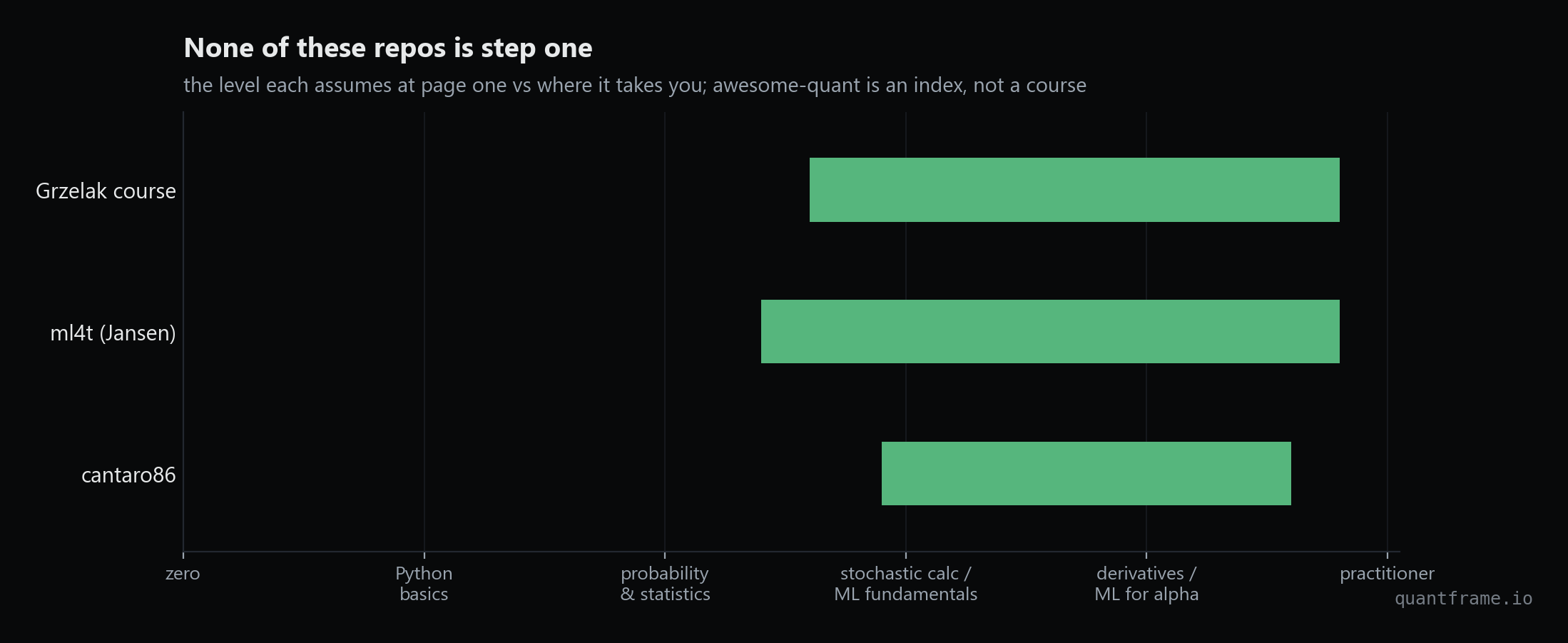
Sequencing. Every serious repo on this list starts past the point where most beginners stand, because advanced people write repos about advanced things. The stretch that gets you to their starting line, Python, probability, statistics, linear algebra, a first look at stochastic calculus, is exactly the stretch these repos skip. The internet hands you lectures 5 through 14 of a course whose lectures 1 through 4 you are expected to bring yourself.
Feedback. A video cannot tell you whether you understood it, and a notebook runs top to bottom whether or not you could have written cell three yourself. Passive completion feels like progress and measures nothing.
Practice. Reading a derivation is not doing mathematics, and running someone else's code is not writing code. Here is a concrete self-test, the kind of thing you should be able to write comfortably before any of the four repos will pay off:
self_test.pypython
import numpy as np

rng = np.random.default_rng(7)
T, steps, paths = 1.0, 252, 10_000
dt = T / steps

z = rng.standard_normal((steps, paths))
log_returns = (0.05 - 0.5 * 0.2**2) * dt + 0.2 * np.sqrt(dt) * z
prices = 100 * np.exp(np.cumsum(log_returns, axis=0))

print(prices[-1].mean())  # about 105.1: drift at 5% on a start of 100
Ten lines, and it is a full Monte Carlo simulation of geometric Brownian motion. If you can write this from scratch and explain why the half-times-variance term is in there, you are ready for the repos above. If not, that is completely fine, but the repos are not where your next month should go, and starring them will not change that.
Each bar starts where the repo starts making sense. The space to the left is your actual first year.
The Ingredients Are Free. The Recipe Is the Hard Part.
None of this is an argument against the four repos. Take them. They are excellent, the authors are generous, and everything I praised above is real. It is an argument against pretending that a pile of graduate material is a plan.
That gap is exactly why I built QuantFrame. You start with a short assessment of what you already know, and it generates a personalized roadmap that sequences everything from where you actually stand, instead of from where a repo author assumed you stand. The math comes as interactive problems you solve directly in the browser, with answers checked mathematically, so feedback is built in instead of bolted on. The coding problems run Python right in the browser too, no environment setup, and the projects have you build real quant work, the same muscle the repos above train, in an order that respects your foundations.
The free repos are the ingredients, and they are genuinely great ingredients. QuantFrame is the recipe, the kitchen, and the chef telling you what to cook first. Build the foundations in the right order and these four repos stop being walls. They become what they were always meant to be: gifts.
If you want the path instead of the pile, the QuantFrame free trial gives you 3 days of everything: your personalized roadmap, the full problem library, and the projects. Start at quantframe.io. The repos will still be here when you are ready for them.
End of entry
Found this useful?
Likes decide what gets written next.Sign in to like
QuantFrame
Liked this article?
QuantFrame teaches you the math, code, and projects to break into quant. Plus a personalized roadmap built for your background and goals.