The Free Quant Syllabus: Five Courses From MIT and Stanford, and What to Build After Each
Antonije Mirkovic·9 min read
mit · stanford · free-courses · learning-path · quant-career
MIT and Stanford have already published a complete quant education. Five courses, 81 recorded lectures, about a hundred hours of video, every problem set included. Two of the five are graduate courses.
The price is zero. No login, no email wall, and no certificate at the end, because neither platform sells one.
I went through all five course pages this week and pulled what is actually inside each: who teaches it, what the lectures cover, which materials ship with solutions. What follows is the result. The five courses in the order I would take them, and after each one, the project I would build to make it stick.
Because free lectures have a design flaw: they optimize for the feeling of progress. You can follow every derivation on the board and still freeze the first time a real price series lands in front of you and nobody says what to do with it. Theory you have watched is not theory you can use. So every course on this list gets a build attached, a project that forces the material through your own keyboard.
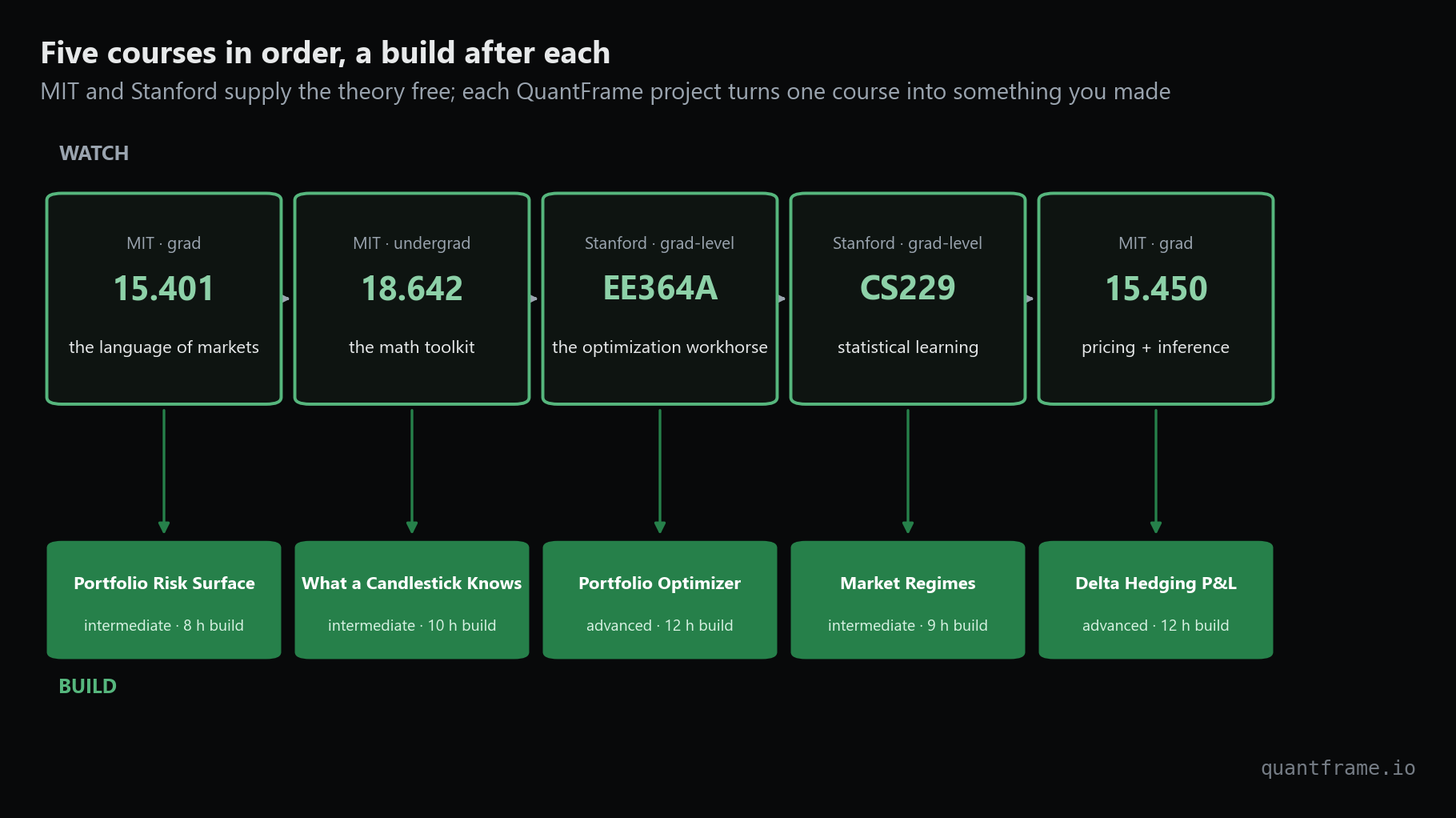
The syllabus. The top row is free; the bottom row is where it becomes yours.
The Order Matters More Than the List
The usual advice is "just watch MIT OCW". That advice fails in two specific ways. People start with the most impressive-sounding course instead of the one their background supports, stall in week two, and conclude quant finance is not for them. Or they finish a course, feel smart for a weekend, and retain nothing they can show.
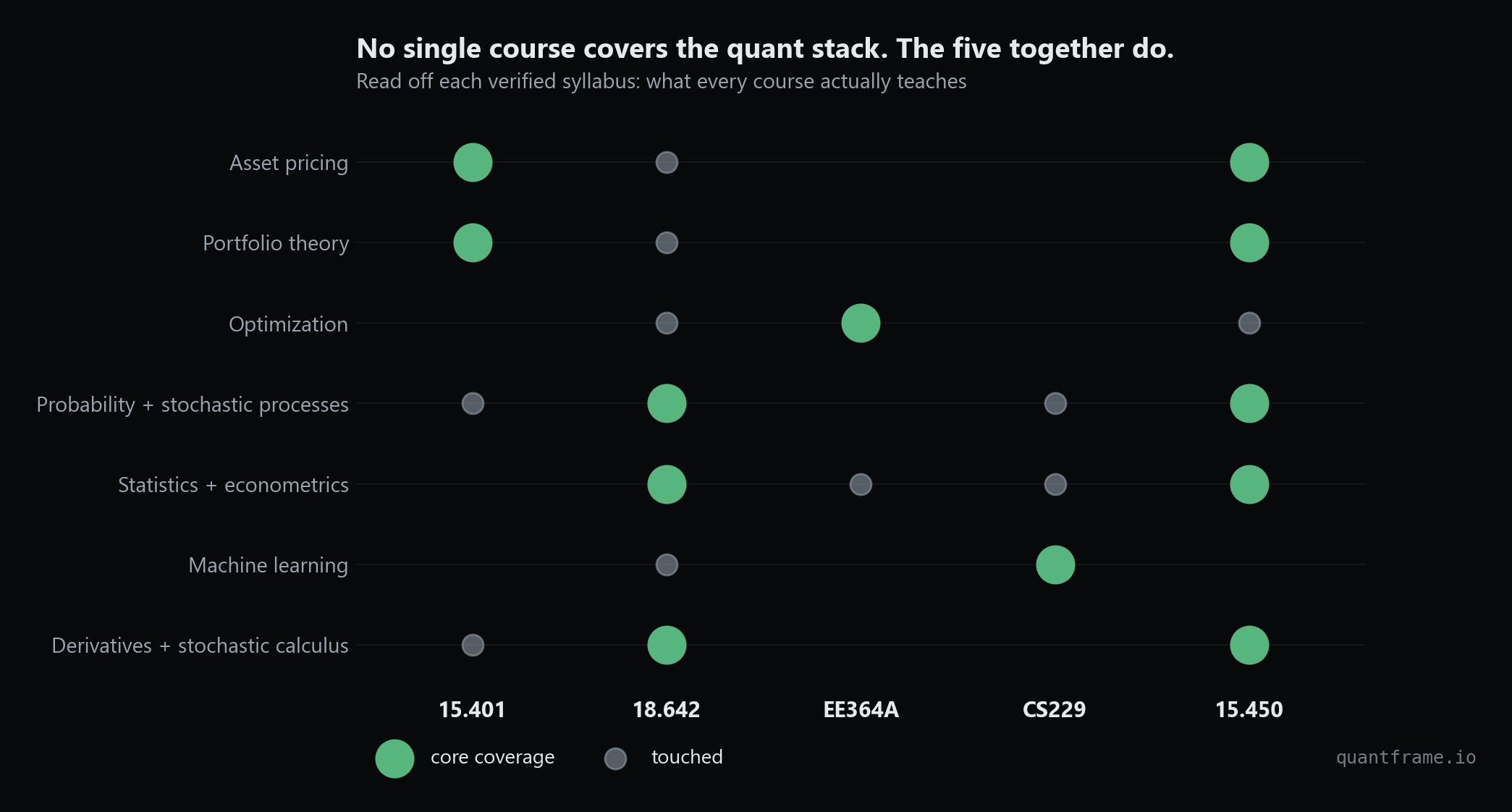
The order below fixes the first failure. Each course leans on the ones before it: 15.401 gives you the language of markets, 18.642 gives you the math toolkit, EE364A gives you optimization, CS229 gives you statistical learning, and 15.450 assumes you are comfortable with essentially all of it.
The builds fix the second failure. More on those as we go.
Read off the five syllabi, one dot per claim. The gaps are why the order exists.
One honest catch before the tour, because the listicles never mention it: one of the five courses has no lecture videos at all. It is also the best one. We will get there.
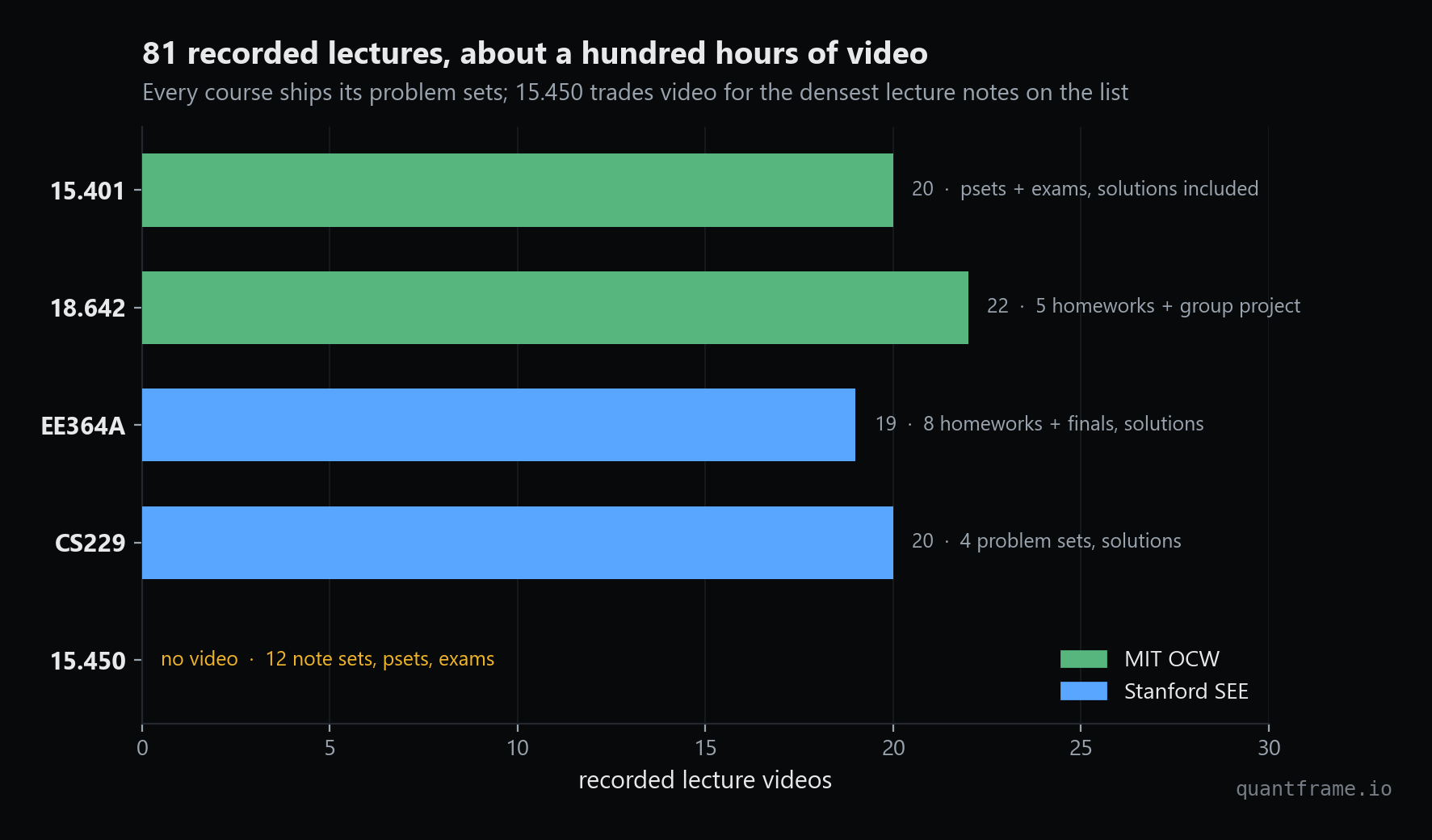
What each course actually ships. The amber row is the one you read instead of watch.
15.401 Teaches the Language Everything Else Assumes
15.401 Finance Theory I is MIT Sloan's graduate introduction to finance, taught by Andrew Lo in the Fall 2008 recording. It covers the core theory of modern financial economics: present value, fixed-income securities, equities, forwards and futures, options, risk and return, portfolio theory, the CAPM and APT, capital budgeting, efficient markets.
All 20 lecture sessions are on video, organized into 12 topic groups. The problem sets come with solutions. So do the exams, midterm and final both.
Two honest notes. The 2008 date is not a defect; everything in this course predates 2008 and survived it, and watching Lo teach efficient markets while the financial system was actively on fire is its own education. And mathematically this is the gentlest course on the list. That is exactly why it goes first: you learn what a portfolio, a forward rate, and a risk premium are before anyone asks you to differentiate them.
The build:Exploring a Portfolio Risk Surface. Lo gives you mean-variance portfolio theory as formulas. The project makes you treat portfolio risk σp2=w⊤Σw as a surface and interrogate it with multivariable calculus: partial derivatives, gradients, the Hessian, Taylor approximations of how your risk moves when the market does. Intermediate, about 8 hours. When you finish, diversification stops being a slogan and becomes a shape you have differentiated.
18.642 Mixes MIT Math With People Who Price Risk for a Living
18.642 Topics in Mathematics with Applications in Finance is the newest item here, a Fall 2024 update of a course MIT has run since 2013. The format is the draw: mathematics lectures alternate with lectures showing where that mathematics earns money.
The staffing makes the point. Alongside MIT's Peter Kempthorne, the course syllabus lists Vasily Strela, global head of fixed income quantitative analytics at RBC Capital Markets, and Jake Xia, managing director of Harvard Management Company and before that of Morgan Stanley. Half the reading list of a quant job description, teaching the class.
The 22 recorded lectures run from bond math and linear algebra through probability, stochastic processes, regression, time series, and volatility modeling, up to Black-Scholes, risk-neutral valuation, and two closing lectures of stochastic calculus. In between sit the practitioner sessions: linear rate products, counterparty risk optimization, principal component analysis as desks actually use it, even a lecture on building the first CFTC-regulated event exchange. Coursework is five homework assignments, a group project, and a final paper instead of an exam. Prerequisites are real: differential equations, probability, linear algebra.
The build:What a Candlestick Actually Knows. The course hands you stochastic processes and volatility modeling; the project asks a sharper question: how much volatility information is hiding in a bar's high and low? You build an exact bar simulator, implement the classic range estimators, measure them honestly, and stress-test them until they break. Intermediate, about 10 hours.
EE364A Is the Optimization Engine Under the Whole Stack
EE364A Convex Optimization I is Stephen Boyd's Stanford course, and for my money it has the best ratio of difficulty to payoff on this list. Nineteen lectures of 69 to 82 minutes each, eight homework sets with solutions, a practice final and a real final with solutions, and the Boyd and Vandenberghe textbook free as a PDF.
The content: convex sets and functions, least squares, linear and quadratic programs, semidefinite programming, duality, interior-point methods. No finance in the course title, and yet this is the most directly employable mathematics here, because portfolio construction in practice is a convex program:
minww⊤Σwsubject to1⊤w=1,w≥0,μ⊤w≥rmin
The textbook solution to mean-variance dies the moment real constraints arrive: long-only rules, position caps, turnover limits. What remains, on every desk that allocates anything, is exactly what Boyd teaches: recognize the problem as convex, hand it to a solver, trust the certificate of optimality.
The build:Build a Portfolio Optimizer. CVXPY from a blank file to a defensible allocation: efficient frontiers, then the real-world constraints that break closed forms, then robustness against your own estimation error. Advanced, about 12 hours, and the single most CV-legible build of the five.
CS229 Is Machine Learning With the Math Left In
CS229 Machine Learning is Andrew Ng's classic Stanford run: 20 lectures, again 69 to 82 minutes each, with 12 sets of written lecture notes, four problem sets with solutions, and review notes on the linear algebra and probability you were supposed to remember.
It covers supervised learning through both generative and discriminative models, SVMs and neural networks, unsupervised learning through clustering and dimensionality reduction, learning theory including bias and variance, and reinforcement learning. The recording is old enough that nobody will show you a transformer. For markets I consider that closer to a feature than a bug: the parts of machine learning that transfer to finance are precisely the parts this course is strongest on, knowing when a model generalizes and what happens when there is little signal and a great deal of noise.
The written notes are the quiet asset. Most people who "did CS229" watched the videos. The ones who did the derivations in the notes own the material.
The build:Discovering Market Regimes Through Structure. Straight application of the unsupervised half of the course: treat return data as geometric structure, reduce its dimensionality, and find market regimes as clusters in the reduced space. Intermediate, about 9 hours, and the moment "the market has moods" turns from a feeling into a matrix decomposition.
15.450 Is the Hardest Course Here, and the Only One You Read
15.450 Analytics of Finance is Leonid Kogan's graduate course at Sloan, and it is the one I would send anyone who claims they have "done the theory". The catalog description is a quant job posting: financial econometrics and statistical inference, dynamic optimization, Monte Carlo simulation, stochastic calculus.
Here is the catch from earlier: there is no video. The course ships as 12 dense sets of lecture notes plus four supplementary handouts, with assignments, recitations, and exams. You work through arbitrage-free pricing, stochastic calculus and option pricing, simulation methods, three lectures of dynamic portfolio choice including dynamic programming, then the econometrics block: parameter estimation, standard errors and tests, small-sample inference and the bootstrap, volatility models.
Reading graduate lecture notes without a lecturer is a skill, and it is the skill the job actually requires, because nobody records a lecture explaining your desk's internal models. That is why this course goes last: arrive with four courses and four builds behind you, and the notes read like a summary of things you almost know.
The build:Delta Hedging: What It Really Costs to Replicate an Option. The capstone. You build a discrete-time hedging engine, decompose its P&L into the theta bleed ΘΔt against the gamma term 21Γ(ΔS)2, find the cost-optimal rebalancing frequency, and then watch the Black-Scholes hedge break under jumps and stochastic volatility. Advanced, about 12 hours. Every pricing formula in 15.450 is a claim about a hedge; this is where you test the claim.
What This Means For You
1. Take them in order. The sequence is a dependency graph, not a ranking. Starting with 15.450 because it sounds the most advanced is how motivated people quit in week two.
2. The solutions are the product. Three of the five grade you back: 15.401 publishes its problem sets and exams solved, EE364A its homeworks and finals, CS229 its problem sets. Solutions are what make self-study honest: you find out you were wrong in private, where it is cheap.
3. Watch about two hours for every hour you build. The list is roughly a hundred hours of video; the five builds total about 51 hours of work. If your ratio is a hundred to zero, you are not studying, you are collecting.
4. Artifacts beat certificates. These courses grant no certificate, and it costs you nothing, because nobody is hired off a certificate anyway. Five finished builds you can open in front of another person are a different conversation entirely.
The five builds in this article are QuantFrame projects: interactive, in the browser, with the math and coding practice that leads up to them. The lectures above are free forever. When you are ready to do the build half, your personalized roadmap is at quantframe.io.
End of entry
Found this useful?
Likes decide what gets written next.Sign in to like
QuantFrame
Liked this article?
QuantFrame teaches you the math, code, and projects to break into quant. Plus a personalized roadmap built for your background and goals.