Five books. 2,851 pages. Every one of them free, from the publisher's own site or the author's.
Three are Cambridge University Press textbooks whose authors talked the publisher into leaving the PDF online; Boyd and Vandenberghe's two book pages carry the identical sentence, word for word: "Copyright in this book is held by Cambridge University Press, who have kindly agreed to allow us to keep the book available on the web." The fourth is Harvard's probability textbook, free because the course page says so. The fifth comes from the authors' own site in three editions, the newest in Python.
I spent this week opening all five. Not the reviews, the files: page counts, tables of contents, the prefaces where the authors admit what the book assumes. Then what each official page ships around it, because the lectures and the exercise sets are the half of the deal reading lists leave out.
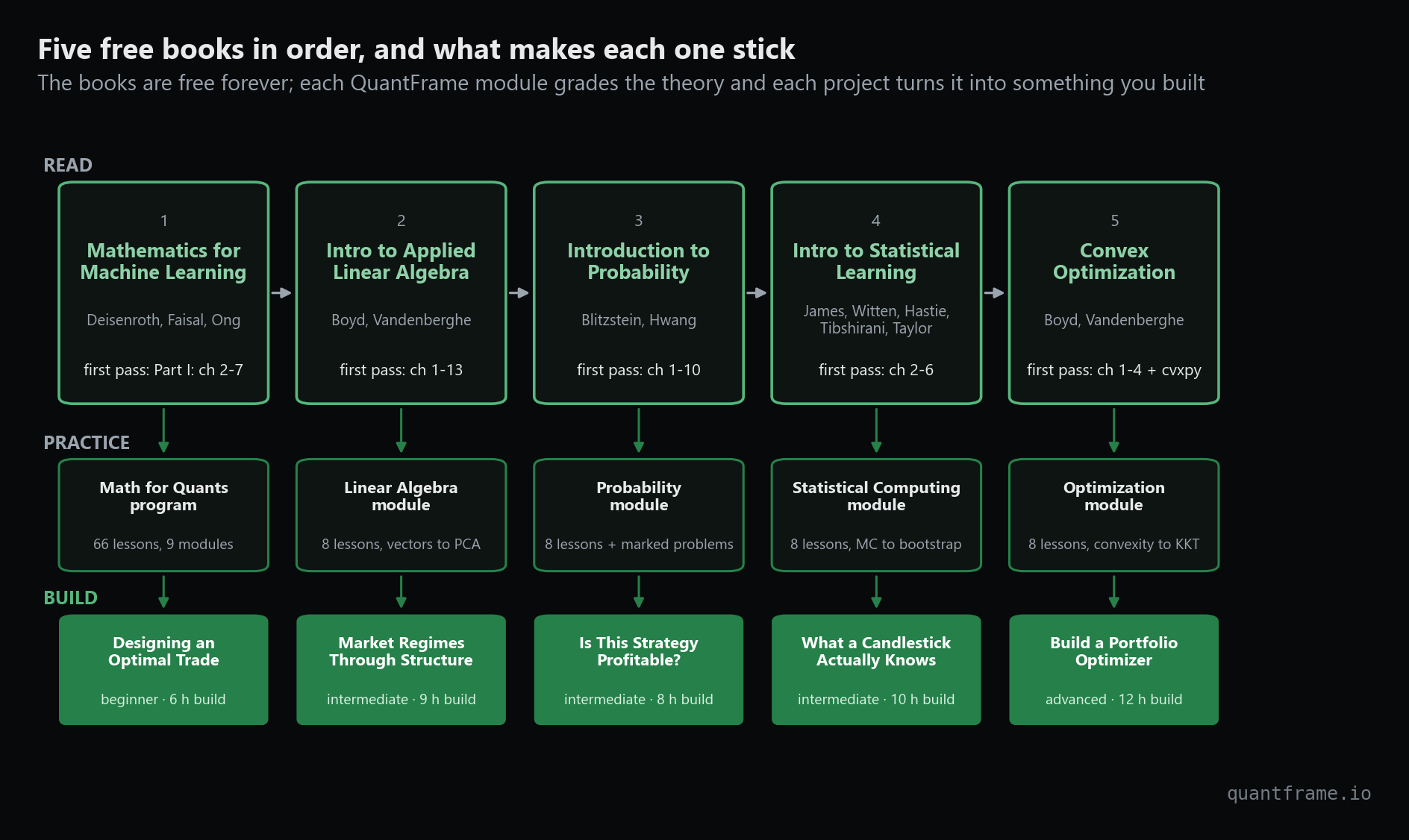
What follows is the shelf in the order I would read it, how much of each book you need on a first pass, and after each one, the practice that stops it evaporating.
The shelf. The top row is free forever; the two rows under it are where the theory turns into something you can do.
The Order Is a Dependency Graph, Not a Ranking
The usual advice is "just read Boyd", or its cousin, start with the hardest book so you do not waste time. Both fail the same way. Convex Optimization's own preface asks for "a good knowledge of advanced calculus and linear algebra" and calls itself "a natural next topic after advanced linear algebra (topics like least-squares, singular values)". Start there without that and you stall in chapter 3, decide you are not a maths person, and the shelf gathers dust.
So the order is set by what each book assumes. Applied linear algebra assumes nothing: its preface says a course "for students with little or no background in linear algebra can focus on parts I and II", and the book "does not require any knowledge of computer programming". Probability assumes single-variable calculus. Statistical learning leans on both, lightly. Convex optimization leans on all of it, hard.
That gives the sequence: the on-ramp if you need it, linear algebra, probability, statistics, optimization last. Linear algebra and probability are independent, so run them side by side if you like. If you have interviews in eight weeks, ignore all of this and read the probability book first.
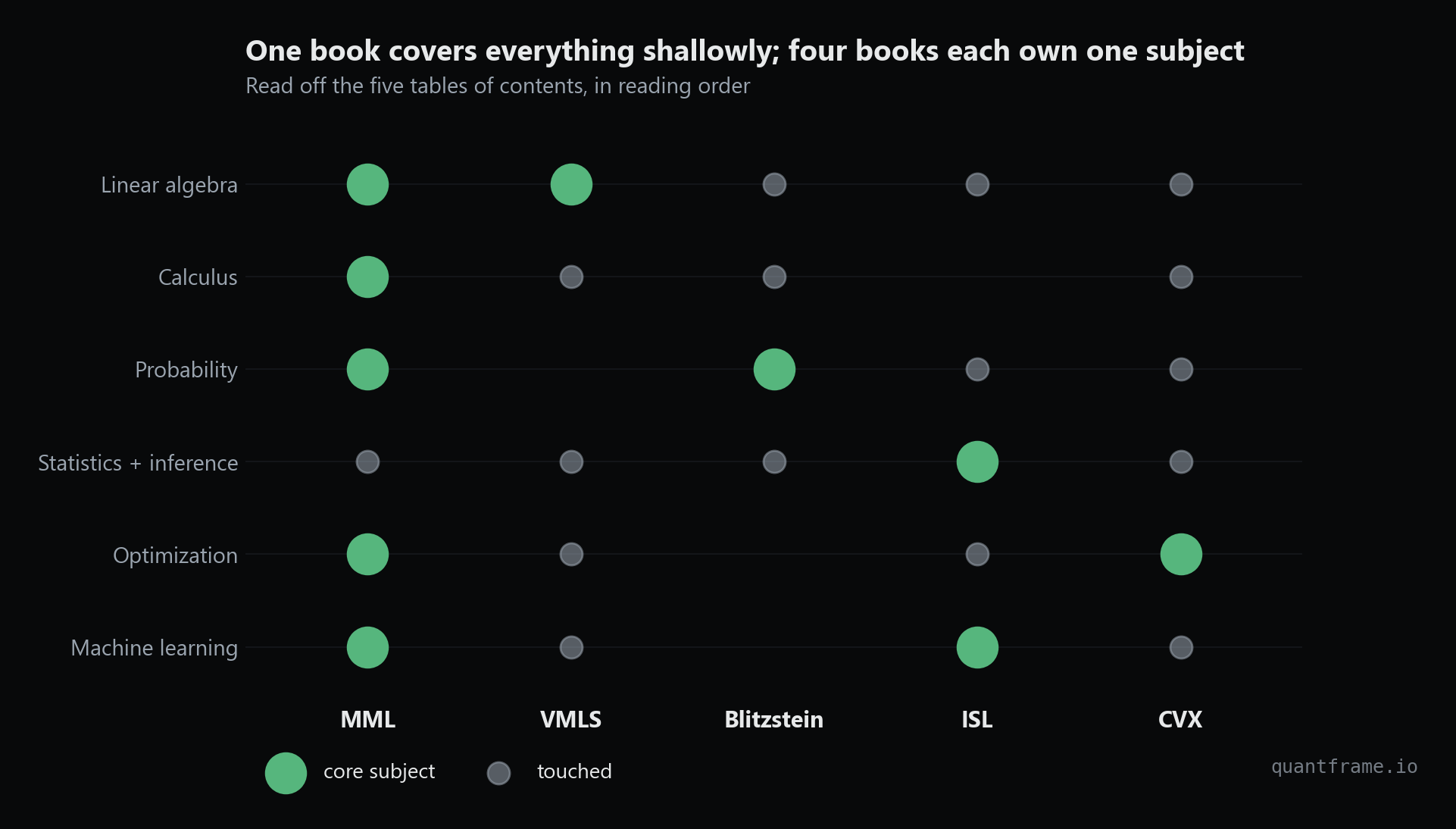
Read off the five tables of contents. The on-ramp touches everything; the other four each own a subject.
Mathematics for Machine Learning Is the On-Ramp, Not the Destination
If the other four look like a wall, Mathematics for Machine Learning by Deisenroth, Faisal and Ong is the ladder. Cambridge published it in April 2020 and the authors' page states the deal plainly: "We will keep PDFs of this book freely available." They mean it in the present tense: the current file is stamped 15 January 2024, and in March 2025 they added an extra chapter on integration methods that the printed book does not have.
The authors are honest about what it is for: "we aim to provide the necessary mathematical skills to read those other books." Use it that way. Part I is the foundations: linear algebra, analytic geometry, matrix decompositions, vector calculus, probability, continuous optimization. Chapters 2 to 7 run from page 17 to 248, 232 pages of the 417, and they are the only part you need on a first pass. Part II applies them to regression, PCA and mixture models.
Read Part I, then leave. Come back when a later book uses a Jacobian or a singular value decomposition and you cannot remember what it is.
Alongside it: Jupyter tutorials with solutions for regression, PCA and Gaussian mixtures, and an extra exercise set with solutions, which matters because the book's own solutions are instructor-only. No lecture videos exist; the book is the course.
Where it sticks: QuantFrame's Math for Quants program covers Part I's five subjects plus the four MML skips (stochastic processes, differential equations, stochastic calculus, computational methods): 66 lessons in 9 modules, each with a marked quiz. The build: Designing an Optimal Trade, a beginner project where trade size, leverage and stop placement each become a function you differentiate and solve, about 6 hours.
Applied Linear Algebra Is the Subject Everything Else Is Secretly Made Of
This is the one I would argue with people about. PCA, factor models, regression, covariance cleaning: almost everything you meet later is linear algebra in a costume.
Introduction to Applied Linear Algebra by Boyd and Vandenberghe teaches least squares like a tool you pick up and use. Three parts over 473 pages: Vectors (chapters 1 to 5), Matrices (6 to 11), Least squares (12 to 19). The preface says which part pays: "Part III, on least squares, is the payoff, at least in terms of the applications," and portfolio optimization is on that list.
The core idea fits in one line. With more equations than unknowns, the least squares solution to Ax≈b is
x^=(A⊤A)−1A⊤b
and chapter 13 spends 40 pages showing that regression, curve fitting and a good share of what gets called machine learning is this equation with different matrices plugged in. First pass: chapters 1 to 13, 282 pages. Return to chapters 16 and 17, constrained least squares, the moment you touch a portfolio, because a portfolio with a budget constraint is exactly that problem.
It is a course, not just a book. The full Stanford lecture series is on YouTube, 54 videos from Stanford Online, and the book page adds slides, a Julia companion, a 77-page extra exercise set the authors still update (dated December 2025) and a Python companion by Leung and Matsypura. The honest catch: no public solutions anywhere. The data tells you whether your fit is right; nobody marks your proofs.
Where it sticks: the Linear Algebra module, eight lessons from vectors through projections, eigenvalues and covariance matrices to a quant version of PCA, each with a graded quiz. Then Discovering Market Regimes Through Structure: real return data treated as geometry, reduced in dimension, regimes found as clusters. Intermediate, about 9 hours, and the moment "the market has moods" becomes a matrix decomposition.
Blitzstein Is the Interview Book
If you only read one book on this list, read this one. Most probability questions I have seen come out of quant interviews are conditioning and expectation dressed up as a story about coins, cards or a stick broken in two places. Introduction to Probability by Blitzstein and Hwang trains you to see the structure under the story instead of freezing.
It is the textbook of Harvard's Stat 110: second edition, CRC Press, February 2019, 634 pages in print, with a free online version of the same edition linked from the course page. One honest limit: the free file is view-only. It reads in the browser and does not download.
Thirteen chapters. The first pass is 1 to 10, counting and conditioning through expectation, joint distributions and conditional expectation to inequalities and limit theorems. That is the interview core. Markov chains, MCMC and Poisson processes fill chapters 11 to 13 for later.
The identity the book turns on, and the one that solves an absurd number of interview problems, is Adam's law:
E[X]=E[E[X∣Y]]
Condition on the first step, take the expectation of what remains, and the broken stick, the gambler's ruin and the coupon collector all fall the same way. Blitzstein teaches it as a habit, not a formula. The book is also a pleasure to read, which almost no probability book manages, and every chapter ends with the calculations run in R.
The bundle around it is the best on the shelf: the full lecture series on Harvard's YouTube channel, 34 lectures across 35 videos; strategic practice problems by topic with the solutions posted alongside; and a free edX version, Stat110x. Book, lectures and marked practice, one page.
Where it sticks: the Probability and Random Variables module, eight lessons from sample spaces through Bayes' rule and joint distributions to the central limit theorem, volatility and value at risk, backed by 962 marked practice problems, with whole categories for conditional probability, expected value and Bayes' rule. Then Is This Trading Strategy Actually Profitable?: a noisy strategy with costs and one decision, trade it or not, justified with expected value per trade. Intermediate, about 8 hours.
Statistical Learning Is Statistics Before It Becomes Machine Learning
The one people actually finish. An Introduction to Statistical Learning by James, Witten, Hastie and Tibshirani, with Jonathan Taylor for the Python edition, explains regression, resampling, regularisation and trees without hiding behind notation, and the labs have you running the methods rather than reading about them.
Every edition is free from the authors' site: R in 2013, a second R edition in 2021, Python in 2023. The Python PDF is 613 pages over 13 chapters. First pass: chapters 2 to 6, pages 15 to 288, 274 pages covering statistical learning, regression, classification, resampling, model selection and regularisation. That block holds the bias-variance tradeoff, cross-validation and the bootstrap, and those three ideas are the difference between a backtest and a delusion. The rest waits in chapters 7 to 13.
Around the book: a free edX course in R and Python flavours, 11 weeks at three to five hours a week; 104 lecture videos from Stanford Online plus 33 walking the Python labs; thirteen slide sets; the lab notebooks and the ISLP package on GitHub. No official exercise solutions, the one hole in the package.
Hastie and Tibshirani also wrote The Elements of Statistical Learning with Friedman, the harder book everyone name-drops and nobody finishes. Free too, with Springer's permission this time. Start here, go there later.
Where it sticks: the Statistical Computing module in Code for Quants, eight lessons that implement what ISL describes: Monte Carlo, estimators and confidence intervals, hypothesis testing, the bootstrap, regression, autocorrelation, and the statistics of real returns. Its capstone is the build, What a Candlestick Actually Knows: treat volatility estimators as random variables, measure their efficiency instead of quoting textbook numbers, and stress-test them until they break. Intermediate, about 10 hours.
A Portfolio Is Not Picked, It Is Solved For
Convex Optimization is the hardest book here and I will not pretend otherwise. Neither do the authors: "Developing a working knowledge of convex optimization can be mathematically demanding," says the preface. It is also the book that makes portfolio construction stop feeling like magic. Risk budget, transaction costs, position limits, turnover: all constraints on one optimisation problem, and this is where that sentence becomes something you can write code for.
In the form a desk would run, the problem is
minww⊤Σw−γμ⊤wsubject to1⊤w=1,0≤w≤c,∥w−w0∥1≤τ
where γ trades risk against return, c caps every position and τ limits turnover from the current book w0. Nothing here has a closed form once the caps and the turnover limit are in, and nothing needs one: the problem is convex, so a solver finds the global optimum and certifies it. Chapter 4 teaches you to recognise that shape.
Read chapters 1 to 4, 214 of the 714 pages, then go and build something with cvxpy. That is honestly how most people get it:
portfolio_qp.pypython
import cvxpy as cp
import numpy as np

n = 8
rng = np.random.default_rng(0)
mu = rng.normal(0.06, 0.03, n)                 # expected returns
A = rng.normal(size=(n, n))
Sigma = A @ A.T / n + 0.02 * np.eye(n)         # a covariance matrix
w0 = np.full(n, 1 / n)                         # current book

w = cp.Variable(n)
gamma, cap, turnover = 2.0, 0.25, 0.40
objective = cp.Minimize(cp.quad_form(w, Sigma) - gamma * mu @ w)
constraints = [cp.sum(w) == 1, w >= 0, w <= cap,
               cp.norm1(w - w0) <= turnover]
cp.Problem(objective, constraints).solve()
print(np.round(w.value, 3), "turnover used:", round(float(np.abs(w.value - w0).sum()), 3))
Chapter 5, duality, explains why the solver's certificate can be trusted; Part III only matters if you intend to write a solver.
Cambridge holds the copyright and agreed to leave the book on the web anyway, beside Boyd's Stanford slides (updated summer 2023), the extra exercises on GitHub and the CVXPY source for the book's examples. Two runs of the course are recorded: 2008 on Stanford Engineering Everywhere, 19 videos, and 2023 on YouTube, 18. Solutions, as with the linear algebra book, are instructor-only.
Where it sticks: the Optimization module, eight lessons from first-order methods through convexity, constrained optimisation and the KKT conditions to quadratic optimisation with quant case studies. Then Build a Portfolio Optimizer: CVXPY from a blank file to a defensible allocation, efficient frontiers first, then the constraints that kill the closed forms, then robustness against your own estimation error. Advanced, about 12 hours, and the most CV-legible build of the five.
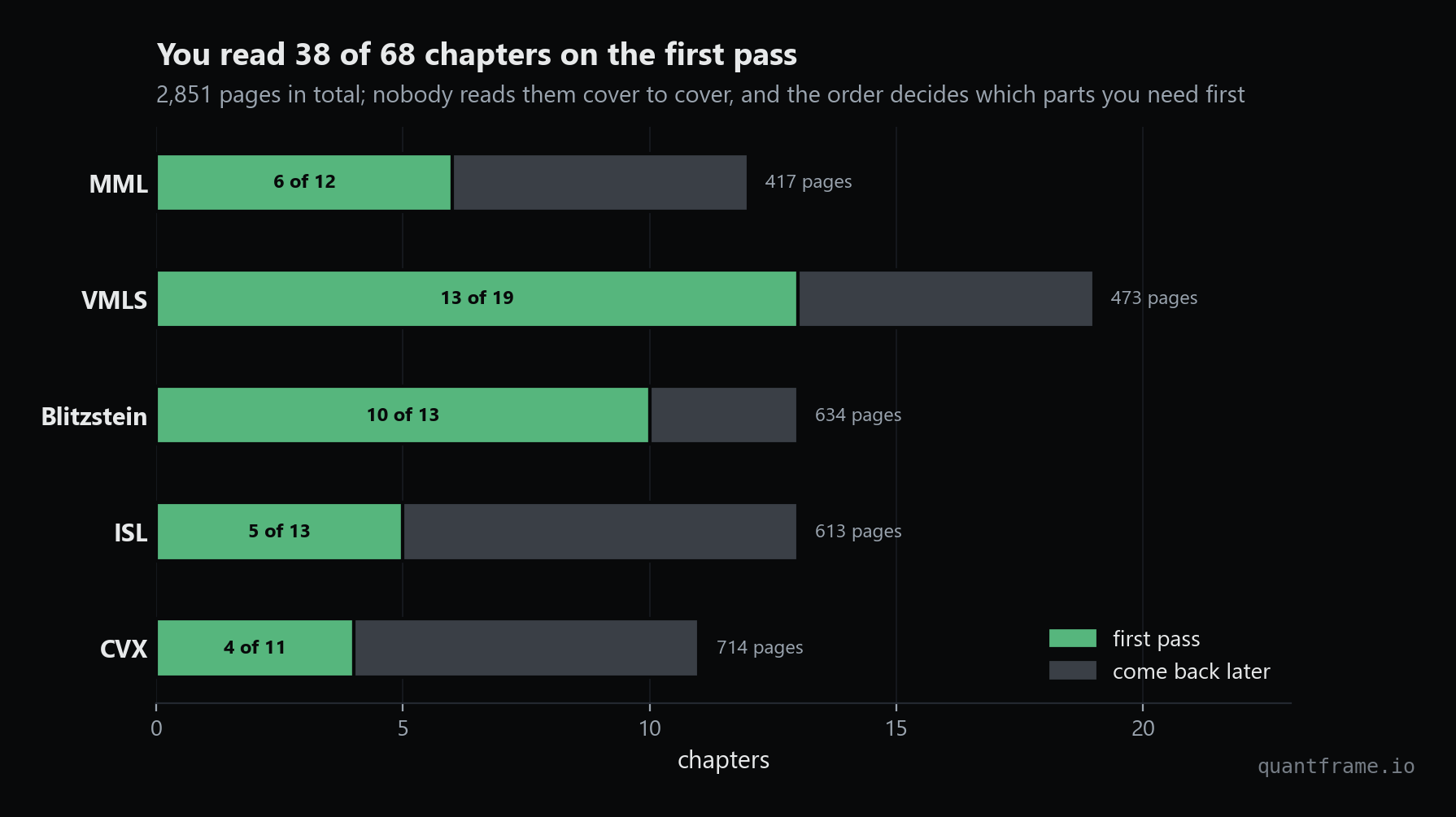
You Read 38 of 68 Chapters on the First Pass
Add it up: 38 of the 68 chapters. For the four books whose free PDFs give chapter page numbers, that is 1,002 of 2,217 pages, 45 percent. The Harvard book adds 634 more in print.
The green is the first pass. Nobody reads these cover to cover; the order decides which parts you need before the next book.
That is still a thousand pages of mathematics. The linear algebra book alone fills a 15-week semester by its authors' count, and the ISL course runs 11 weeks, so treat the shelf as a year, not a summer.
The Books Are Half the Deal
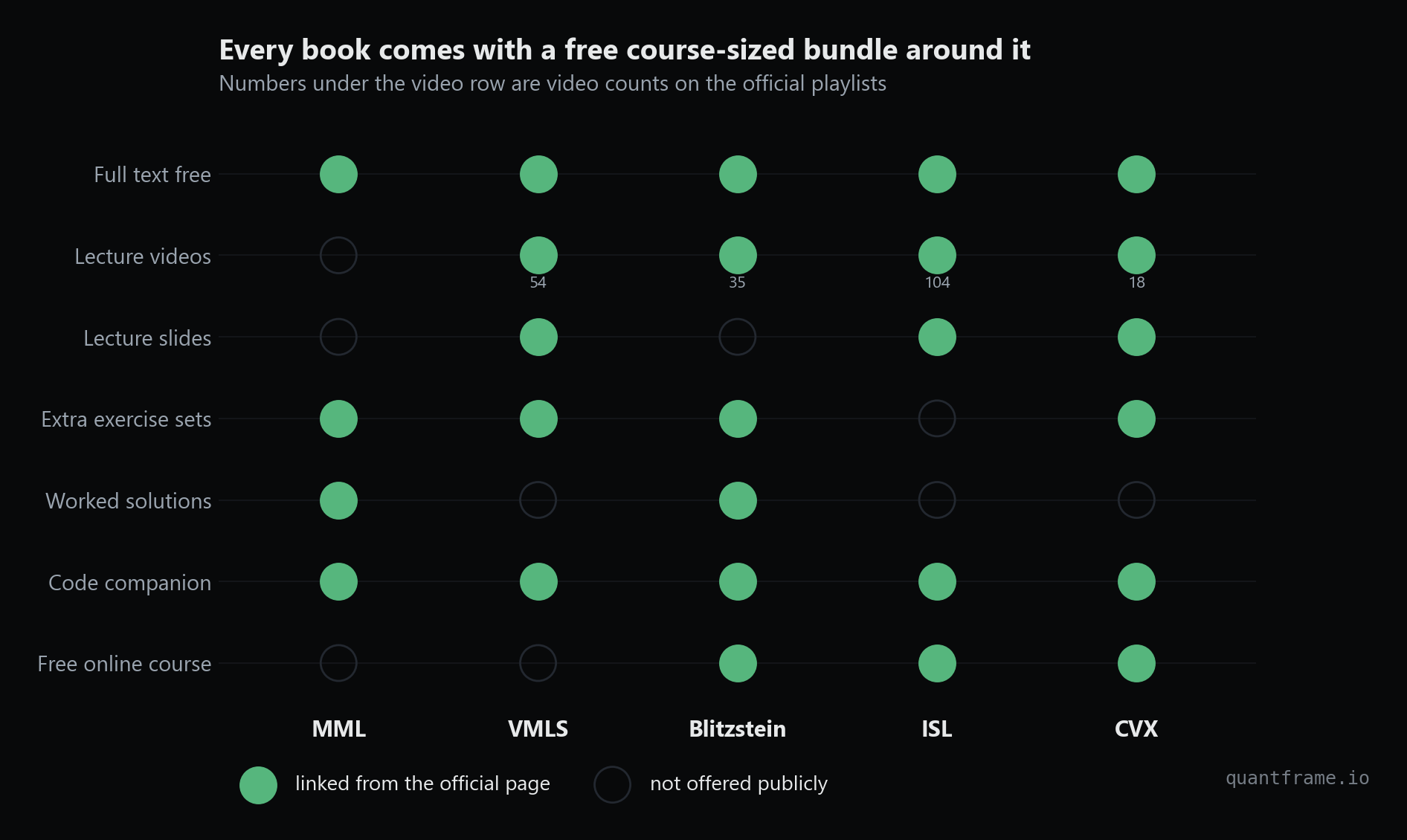
Every official page links more than the PDF. Between them the playlists hold 211 videos, four of the five ship extra exercise sets, and three have a free online course.
What the official pages actually link. The worked-solutions row is the one to look at twice.
The worked-solutions row is the problem with self-study in one line. Only two of the five give you public solutions: the extra exercises for Mathematics for Machine Learning and Stat 110's strategic practice. Both Boyd books keep them for instructors; ISL has none. You can do every exercise in 2,851 pages and never once find out you were wrong, which is the most expensive way to be wrong.
Reading Theory Is Not Practice
You can read all five and still not be able to start a problem. Theory you never use does not stay.
What makes it stay is boring to say and hard to do: an order to follow, exercises that get marked, and projects on real data where the maths has to work. The order is above. The other two are what QuantFrame is for.
Register, answer five questions about what you already know, and the platform builds a roadmap around it: no reteaching the linear algebra you have, straight to the next thing you do not. The 103 lessons across Math for Quants and Code for Quants each end in a marked quiz, the modules end in exams, and the 962 practice problems are graded the instant you submit. Nine projects, five mapped above, take the theory onto real market data: 45 hours of builds, each one you can open in front of another person. The lessons, problems and projects sit behind a free trial; the roadmap is yours the moment you register.
What This Means For You
1. Take them in order. The sequence is a dependency graph; Convex Optimization first is how motivated people quit in chapter 3. The exception: interviews within two months means the probability book first.
2. The first pass is not the book. 38 of 68 chapters, about 45 percent of the pages. Read the part the next book needs, leave, come back.
3. The bundle is the product. 211 videos, four exercise sets, three free courses, and only two books that mark your work. Plan for something that does.
4. Build after each book. The five projects above total 45 hours, and a finished portfolio optimizer says more in an interview than a finished textbook, because nobody can check the textbook.
The five books above are free forever. The order, the marked exercises and the builds are what QuantFrame adds: register at quantframe.io, answer five questions, and your roadmap is waiting.
End of entry
Found this useful?
Likes decide what gets written next.Sign in to like
QuantFrame
Liked this article?
QuantFrame teaches you the math, code, and projects to break into quant. Plus a personalized roadmap built for your background and goals.