Five papers, all free to read, written by some of the biggest names in finance research: Bryan Kelly, Lasse Heje Pedersen, Ivo Welch, Campbell Harvey, Harry Markowitz.
Between them they cover whether published factors replicate, whether they still make money, how to check a backtest, why LLM backtests can be memory, and how to fix mean-variance optimization.
For each one: what it found and the link. At the end: the five questions they add up to, to run on your next backtest.
Most Published Factors Do Replicate
The claim goes around that most strategies in finance papers are fake. Theis Ingerslev Jensen, Bryan Kelly and Lasse Heje Pedersen checked it on 153 factors across 93 countries.
Instead of testing each factor on its own, they use a Bayesian model where factors in the same theme share information, so a weak value factor gets judged together with every other value factor. The 153 factors fall into 13 themes.
The result: 82.4% of US factors replicate. And having this many factors makes the evidence stronger, not weaker, the opposite of the usual multiple testing argument. Every factor return is free to download.
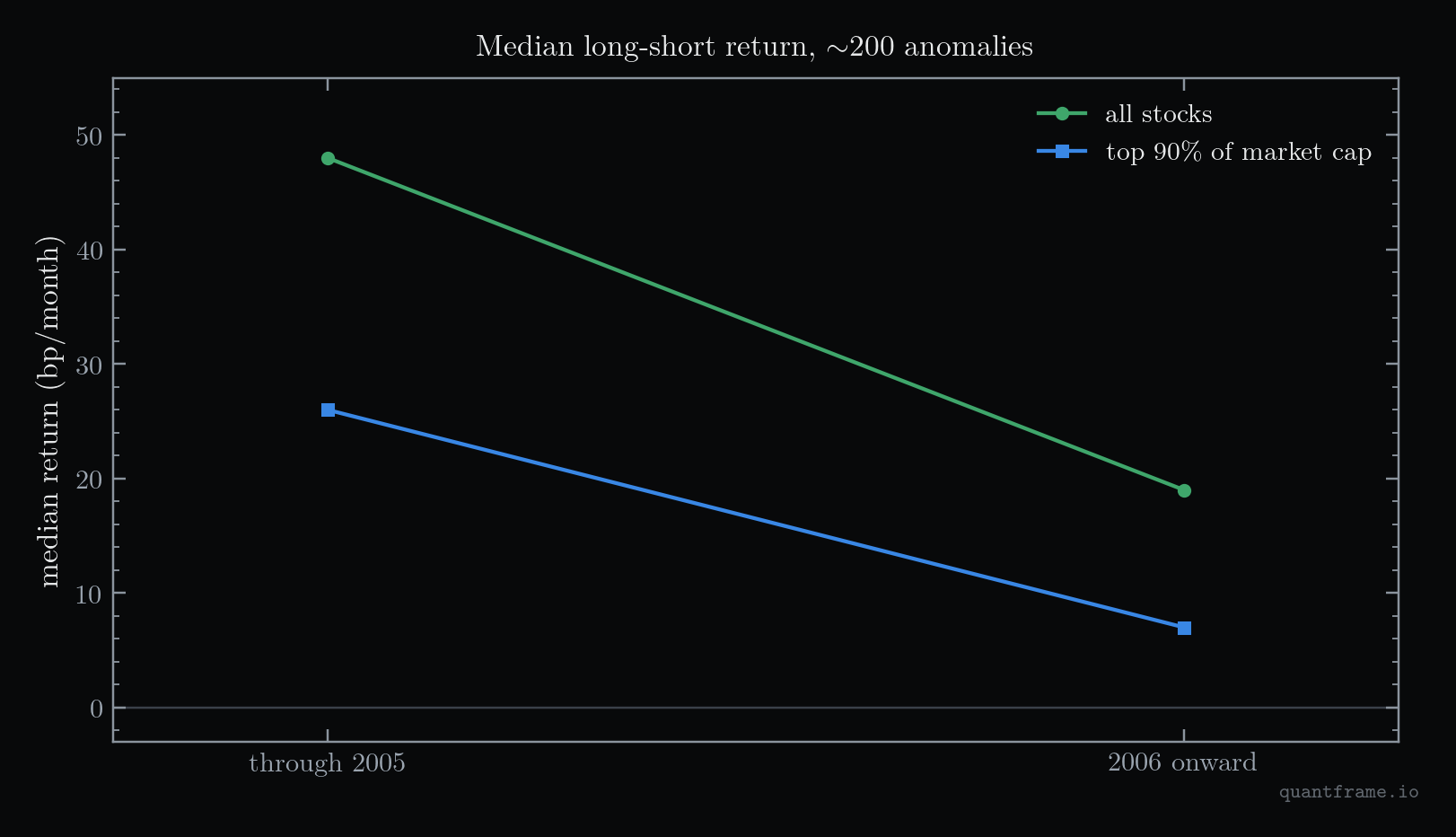
Andrew Chen and Ivo Welch took about 200 published anomalies from the open-source Chen and Zimmermann data and split them two ways: before and after 2005, and all stocks versus the top 90% of market cap, the stocks a fund can actually trade. It came out in July 2026.
Through 2005 with every stock in, the median published anomaly paid 48 basis points a month. From 2006 in the stocks a fund can trade: 7. Microcaps and the old days did most of the work.
Seven basis points a month is about 1% a year, before trading costs. Then they adjust the survivors for luck with one line:
radj=(1−Var(t)1)r
Here Var(t) is how spread out the t-statistics are across all anomalies. Pure noise gives 1. After 2005 it was 1.09, so even the best survivor, 66 basis points a month raw, shrinks to 6.
They also say what their result does not rule out: factor timing, volatility-managed portfolios, machine-learning combinations of signals and alternative data. That is where to look.
A Backtest Needs a Checklist Before It Needs a Sharpe Ratio
Rob Arnott, Campbell Harvey and Harry Markowitz open with a market-neutral strategy built on NYSE stocks from 1963 to 1988 that did even better out of sample through 2015, at nearly 6% alpha a year. It goes long stocks with S as the third letter of their ticker and short the ones with U.
The rest is a seven-point protocol, 22 questions in all, from whether the economic idea existed before you looked at the data to whether you counted every interaction you tried. Start with 20 variables and test a couple of interactions, and you have really opened 190 of them. I'd keep it open next to every backtest you run.
If you've seen a ChatGPT trading strategy with an amazing backtest, read this first. Alejandro Lopez-Lira, Yuehua Tang and Mingyin Zhu show that GPT-4o recalls exact economic and market numbers from before its training cutoff, so a backtest over that period is partly the model remembering the answers.
Telling it to ignore the future doesn't work. Told to ignore everything after 2010, it called whether quarterly GDP growth would beat 2.5% right 98% of the time after 2010, against 40% after its real cutoff. Hiding the names doesn't work either: from a fully anonymized earnings call it named Ethan Allen, Q1 and 2018.
Their rule for anyone building one of these: test on data from after the model's training cutoff, and make that the main result, not a robustness check.
Mean-Variance Bets Biggest on Its Noisiest Portfolios
If you've run mean-variance optimization, you've seen the extreme weights that fall apart out of sample. Lasse Heje Pedersen, Abhilash Babu and Ari Levine find the portfolios behind it: the least important principal components, the ones with the smallest estimated risk. The optimizer takes big leveraged bets on them, and they are mostly noise.
The fix is to shrink every correlation toward zero before you optimize. With Ω the correlation matrix and θ the shrinkage:
Ω~=(1−θ)Ω+θI
Fixing the risk model alone takes only 5 to 10% shrinkage. Around 75% worked in several of their tests, because the same shrinkage also cleans up the noise in your expected returns. It won the 2021 Graham and Dodd Top Award.
Five Papers, Five Questions for Your Next Backtest
Put together, the five papers are a checklist to run on any strategy before you trust it:
Does the idea replicate? Judge it with its theme, not alone.
Does it pay where you can trade? Large stocks, after 2005, after costs.
Did you count every try? Every variable, every interaction.
Could the model have seen the answer? Test after its training cutoff.
Is the optimizer betting on noise? Shrink the correlations first.
The maths behind question 3 is in QuantFrame's Statistical Computing module, where twenty noise signals produce a fake winner in front of you. Question 5 is Portfolio & Risk, where the optimizer blows up on live market data and you shrink it back.
The papers tell you what breaks. When you want to build the tools that catch it, your roadmap is waiting at quantframe.io.
End of entry
Found this useful?
Likes decide what gets written next.Sign in to like
QuantFrame
Liked this article?
QuantFrame teaches you the math, code, and projects to break into quant. Plus a personalized roadmap built for your background and goals.