Ergodicity Economics: Why Expected Value Is Lying to You
Antonije Mirkovic·10 min read
risk management · position sizing · probability · kelly criterion
You're offered a bet.
Flip a coin. Heads, your wealth increases by 50%. Tails, it decreases by 40%.
Quick math: Expected value per flip is 0.5(+50%) + 0.5(-40%) = +5%. Positive edge. You'd take this bet all day, right?
Now imagine you play this game repeatedly, betting your entire wealth each time. After 500 flips, what happens?
I ran this simulation with 1,000 people, each starting with 100 dollars.
The expected value calculation says the "average" person should have roughly 39 billion dollars. Yes, billion. The math checks out: 100 x 1.05^500 is astronomical.
But here's what actually happened: the median person had less than one ten-thousandth of a cent.
Not a typo. The typical outcome of this "positive expected value" bet is complete financial annihilation.
Over 86% of players had less than 1 dollar remaining. Most were effectively bankrupt.
This isn't a trick. This isn't bad luck. This is a fundamental property of how wealth actually evolves through time - and almost everyone gets it wrong.
Welcome to ergodicity economics. And once you understand it, you'll never think about expected value the same way again.
The Coin Flip That Breaks Everything
Let me show you exactly what happens.
The bet is simple:
50% chance: wealth multiplied by 1.5 (you gain 50%)
50% chance: wealth multiplied by 0.6 (you lose 40%)
Expected value per flip: 0.5 x 1.5 + 0.5 x 0.6 = 1.05
That's a 5% expected gain on every single flip. By every standard measure taught in finance and economics courses, this is a good bet. You should take it.
So let's take it. A thousand times.
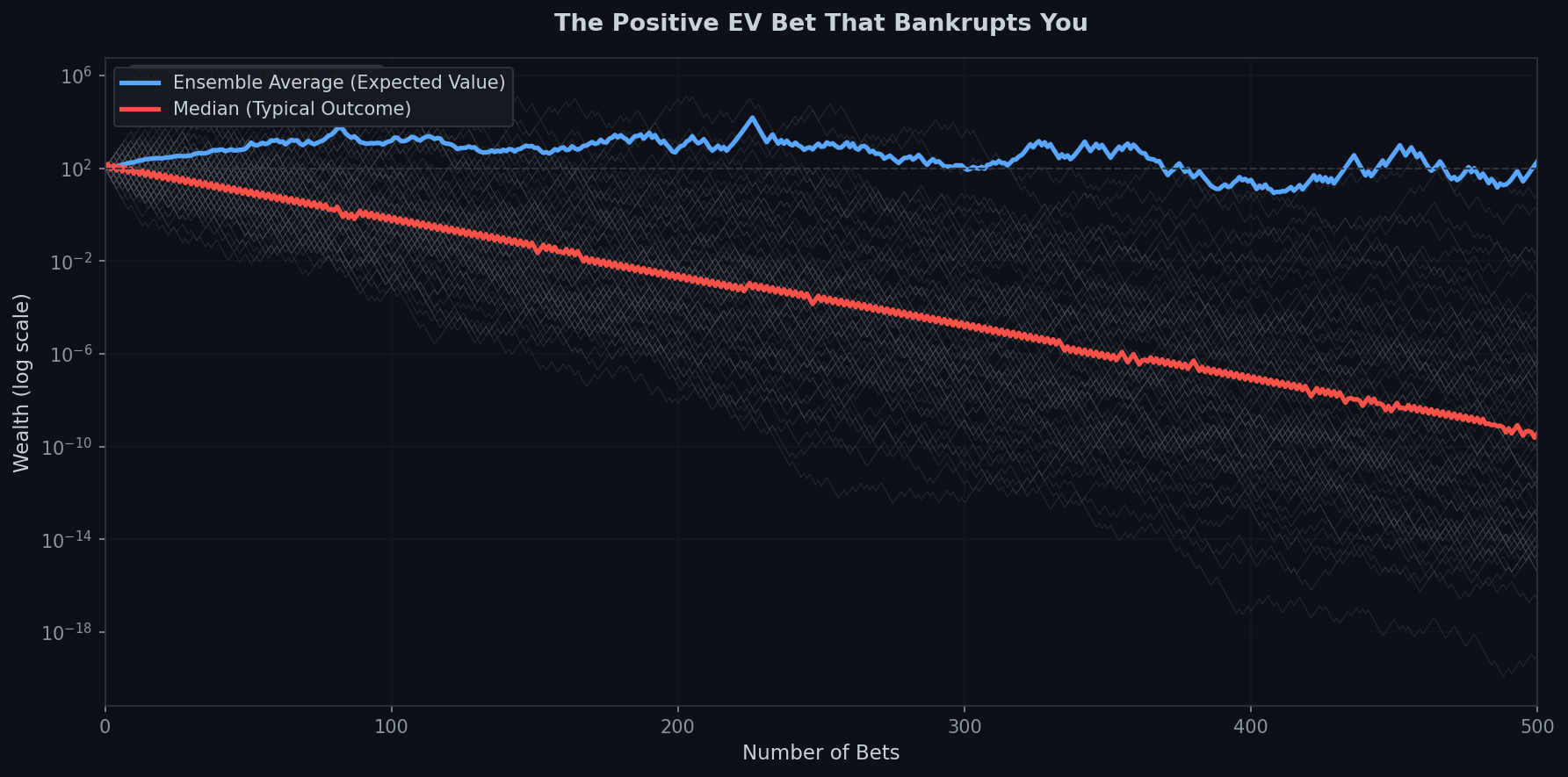
1,000 people play the same positive EV bet. The blue line shows what economists predict. The red line shows what actually happens to the typical person.
The blue line is what economists predict - the "expected value" path. It soars into the billions.
The red line is what actually happens to the typical person. It collapses toward zero.
And those faded lines? Those are individual players. Watch them. Almost all of them crash. A few lucky ones explode upward, dragging the average with them - but they're a vanishing minority.
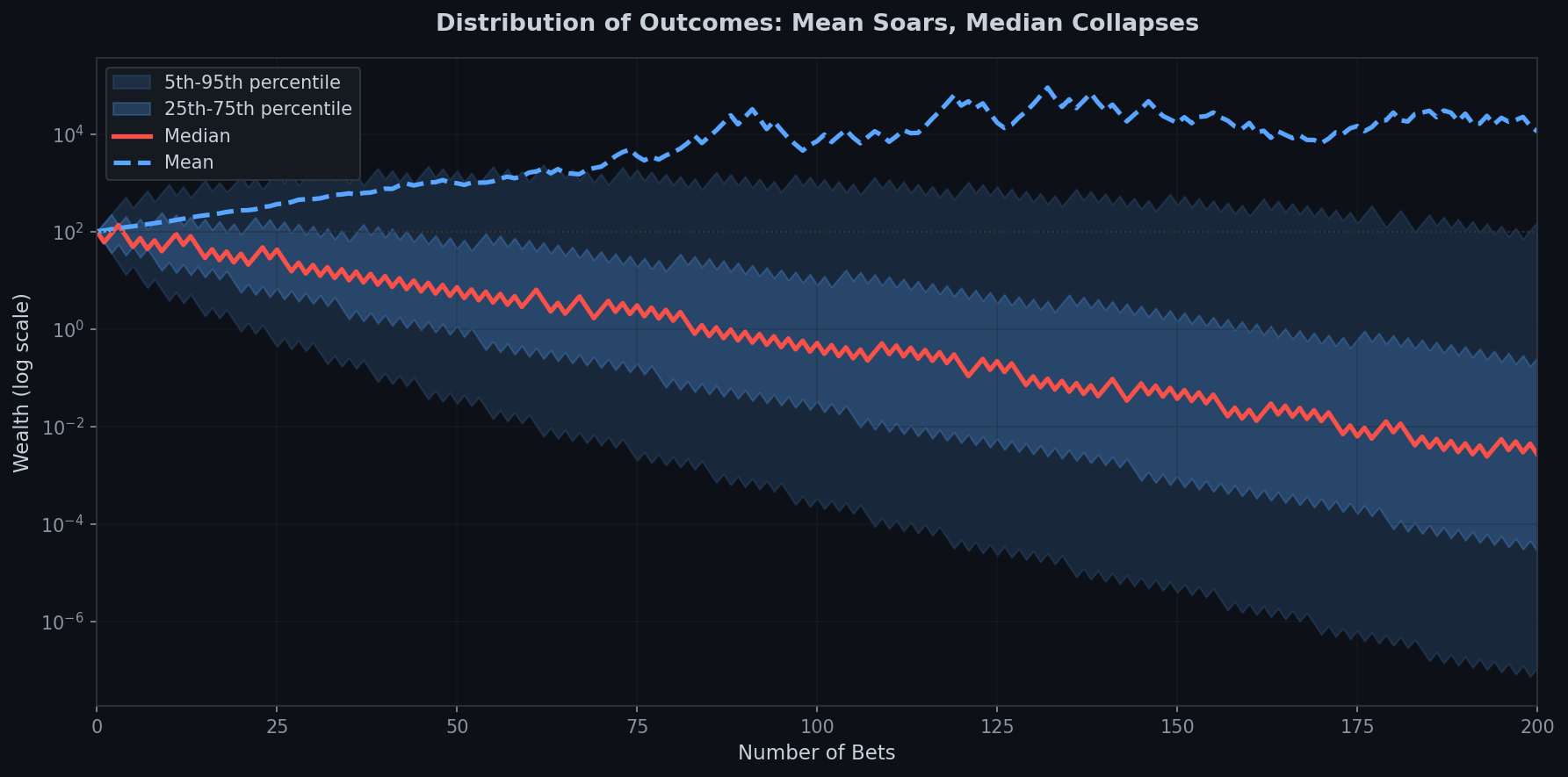
Here's the distribution of outcomes after 500 bets:
The shaded regions show where most outcomes fall. The mean keeps rising. The median keeps falling. Both are mathematically correct.
The shaded region shows where most people end up. It's not near the mean. It's not even close. The median - the 50th percentile, the typical outcome - is asymptotically approaching zero.
Meanwhile, the mean keeps climbing.
How can both be true? How can the "average" outcome be billions while the typical outcome is bankruptcy?
This is where everything you learned about expected value falls apart.
Ensemble vs Time: The Mathematical Betrayal
Here's the core insight that changes everything.
When economists calculate expected value, they imagine a scenario: what if we could run this bet across many parallel universes simultaneously? In universe A, you flip heads. In universe B, tails. Average across all universes, and you get +5% per flip.
This is called an ensemble average. It asks: across many parallel versions of reality, what's the average outcome?
But you don't live in many parallel universes. You live in one. You experience one sequence of flips, one after another, through time. Your wealth compounds through that single path.
This is called a time average. It asks: for one person playing repeatedly, what's the typical long-term outcome?
Here's the brutal truth: for multiplicative processes like wealth, ensemble averages and time averages are not the same.
The ensemble average sees the lucky outliers who hit heads 400 times and became quadrillionaires. It averages them in with everyone else.
The time average sees what happens to any single person. And that person, facing the compounding math of gains and losses, almost certainly trends toward zero.
The mathematical proof is elegant. Your wealth after n bets is:
Wn=W0×i=1∏nRi
where each Ri is either 1.5 (heads) or 0.6 (tails).
That's negative 5.3% per flip in the time-average sense. While the ensemble average predicts +5% growth, the time average predicts -5.3% decay.
The geometric mean - the thing that actually determines your long-term compound growth - is:
1.5×0.6=0.9=0.949
Less than 1. You're shrinking on average. Every flip.
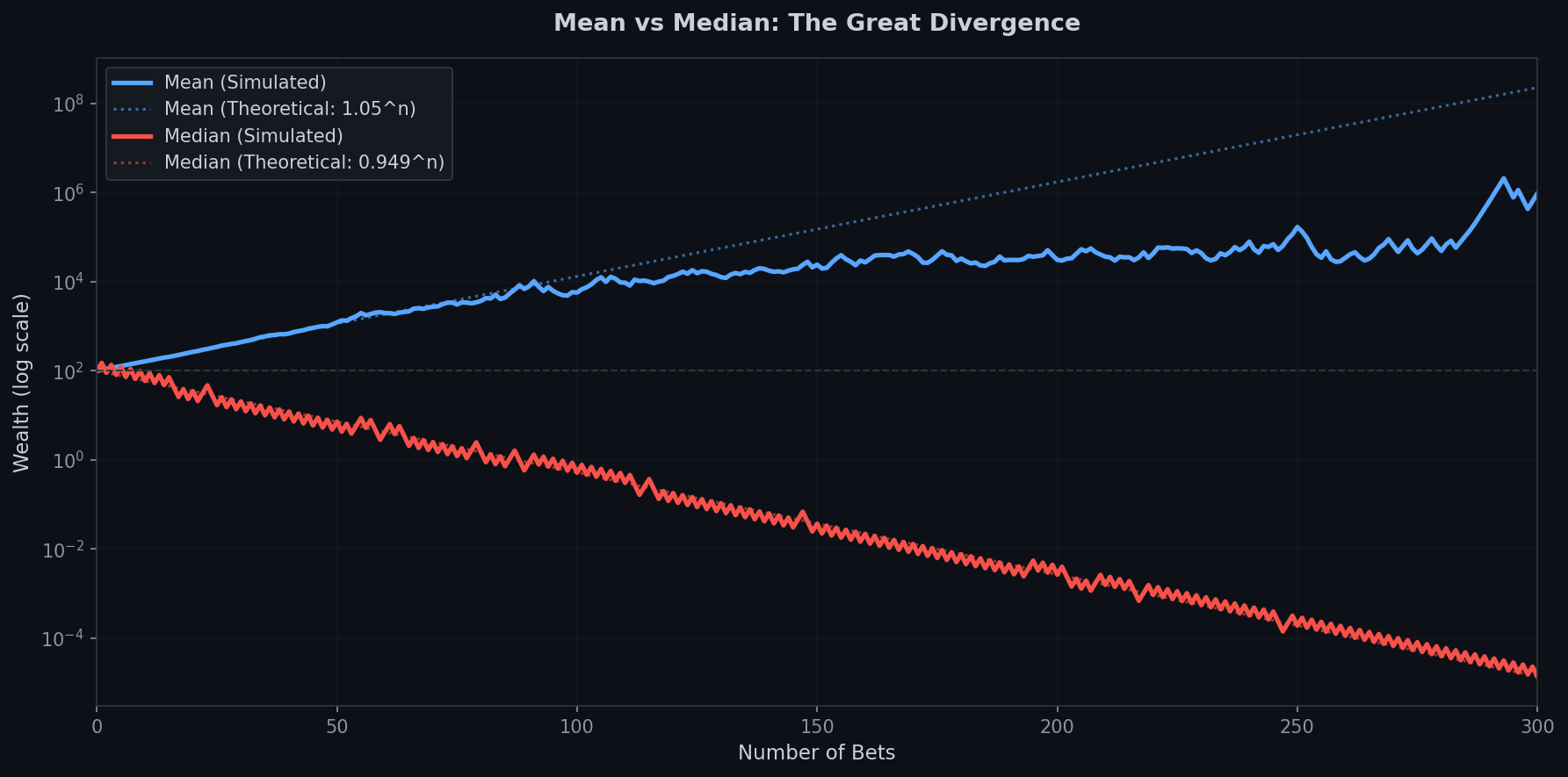
The great divergence. Mean grows at 5% per bet. Median shrinks at 5.1% per bet. Same game, opposite outcomes.
Look at the divergence. The mean (what economists predict) and the median (what happens to you) start the same but then separate exponentially. After 300 bets, the mean is over 100,000 times larger than the median.
This isn't a rounding error. It's a fundamental property of multiplicative dynamics.
The Two Types of Games
Why doesn't this happen in a casino?
Because casino games are additive. You bet 50 dollars. You win 50 dollars or lose 50 dollars. Fixed dollar amounts. Your wealth doesn't multiply - it adds.
In additive games, the ensemble average equals the time average. Expected value works. The math is "ergodic" - the long-term average for one person equals the average across many people.
But in investing, trading, and anything involving percentages of your wealth, the game is multiplicative. You don't win "50 dollars." You win "10% of your portfolio." And losses compound on whatever remains.
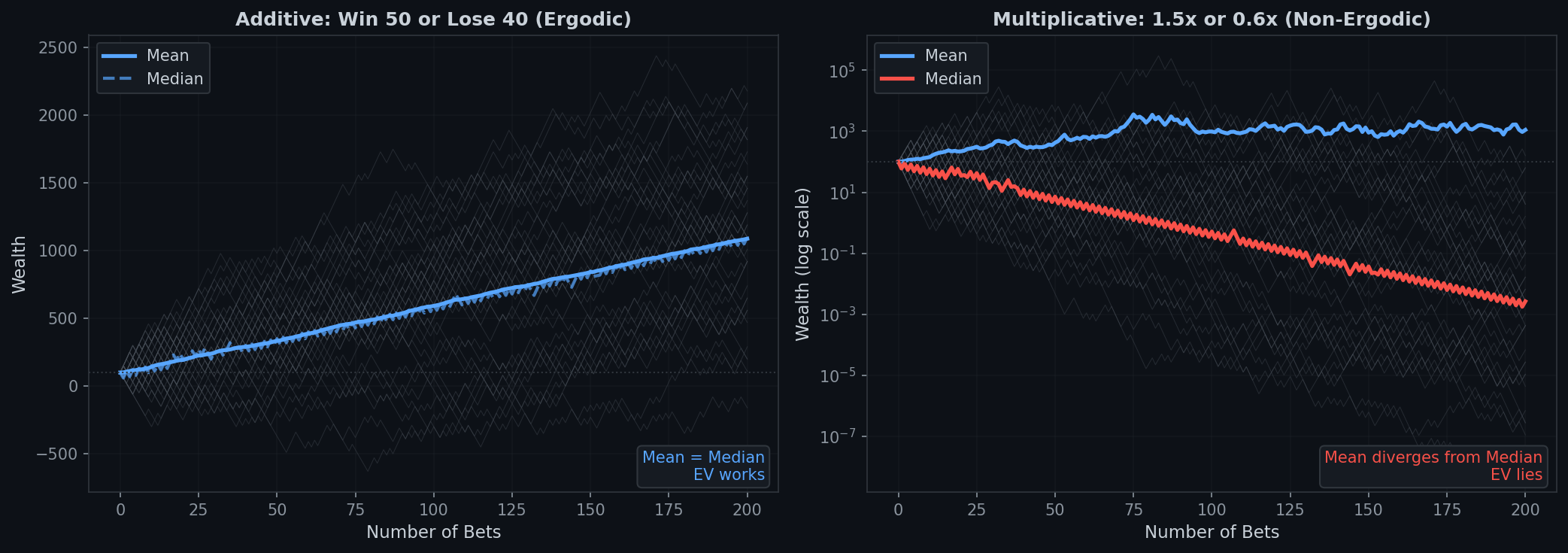
Same odds, same expected value. Additive games are safe - mean equals median. Multiplicative games destroy you - mean diverges from median.
Same bet structure. Same odds. Same expected value.
But on the left (additive), the mean and median converge. Expected value works.
On the right (multiplicative), they diverge catastrophically. Expected value lies.
This is why position sizing matters more than edge.
You can have genuine positive expected value on every trade. You can be "right" in every mathematical sense that finance theory cares about. And you can still go broke with certainty if your position sizes create multiplicative compounding with too much variance.
The game isn't about winning bets. It's about surviving the sequence.
The Kelly Criterion: Mathematics of Survival
This problem was solved in 1956.
John Kelly, a physicist at Bell Labs, was working on signal transmission. He realized that the optimal strategy for maximizing long-term wealth in multiplicative games isn't to maximize expected value - it's to maximize the expected logarithm of wealth.
This automatically accounts for non-ergodicity. It optimizes for the time average, not the ensemble average.
The result is the Kelly Criterion:
f∗=bp(b+1)−1=p−bq
where:
f∗ is the optimal fraction of wealth to bet
p is the probability of winning
q=1−p is the probability of losing
b is the payout ratio (how much you win relative to your bet)
For our original coin flip (50% chance of +50%, 50% chance of -40%), this becomes more complex since it's not a clean "bet and lose everything" structure. But the principle holds: there's an optimal bet size that maximizes long-term growth, and betting more than this amount
actually decreases your expected wealth.
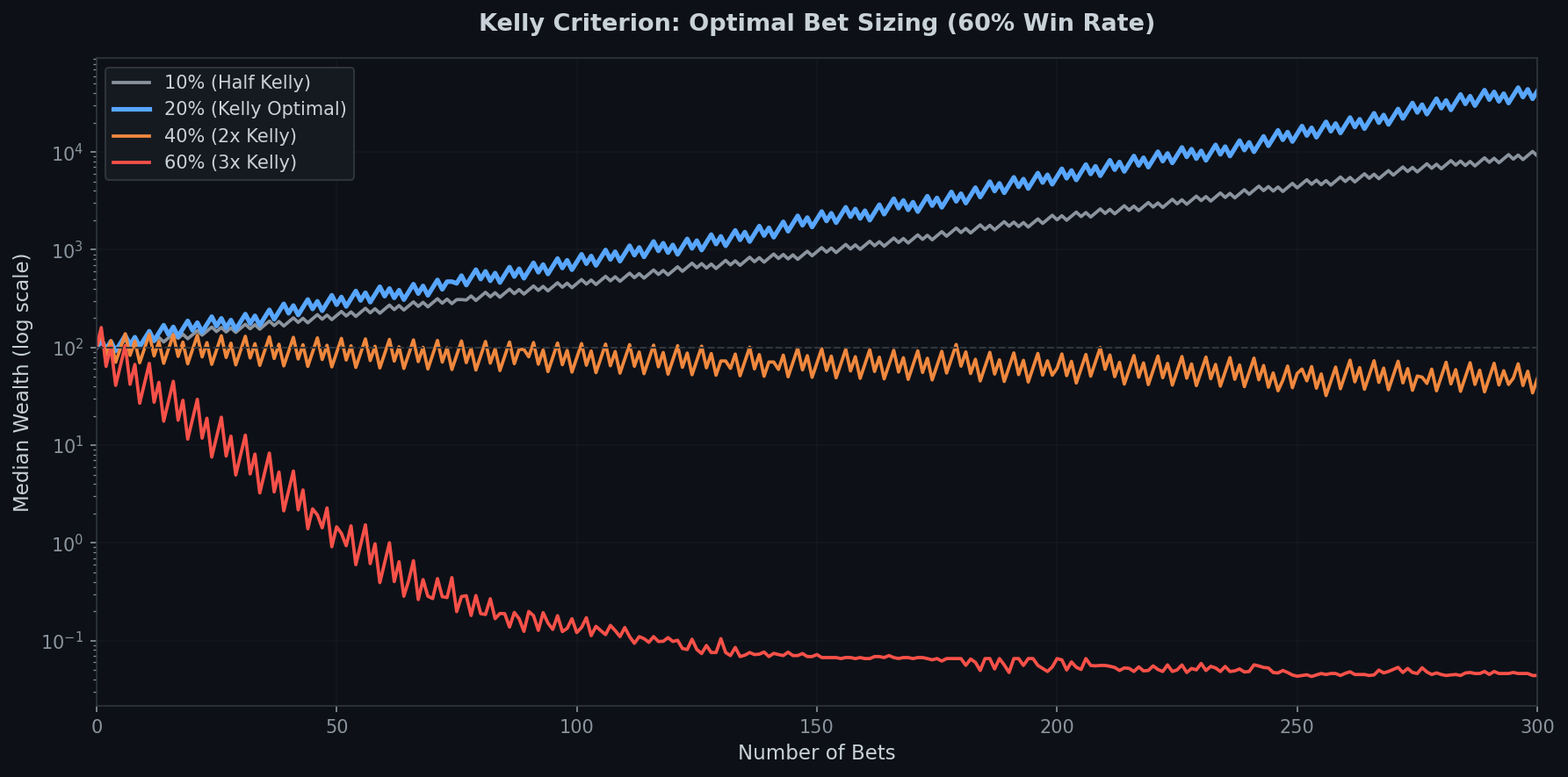
Let me show you with a cleaner example: a 60% chance to double your bet, 40% chance to lose it.
Kelly says: bet 20% of your wealth. No more.
With a 60% win rate, betting 20% of wealth (Kelly optimal) maximizes growth. Betting more than Kelly - even with real edge - leads to ruin.
Look at the left panel. The Kelly-optimal 20% bet (green) grows steadily. Overbetting at 50% or 75% destroys you despite having the same 60% win rate.
The right panel shows why. Expected growth rate peaks at the Kelly fraction. Go beyond it, and your expected compound growth becomes negative - even though the bet has positive expected value on each individual flip.
This is the solution to non-ergodicity: bet less than you think you should.
Full Kelly is theoretically optimal but practically insane (the volatility will break you psychologically). Most professional gamblers and traders use "fractional Kelly" - typically 25-50% of the calculated optimal.
But the core insight remains: expected value on individual bets is not what matters. What matters is expected compound growth over your actual timeline.
Why Traders Get This Wrong
Every trading mistake can be traced back to non-ergodicity.
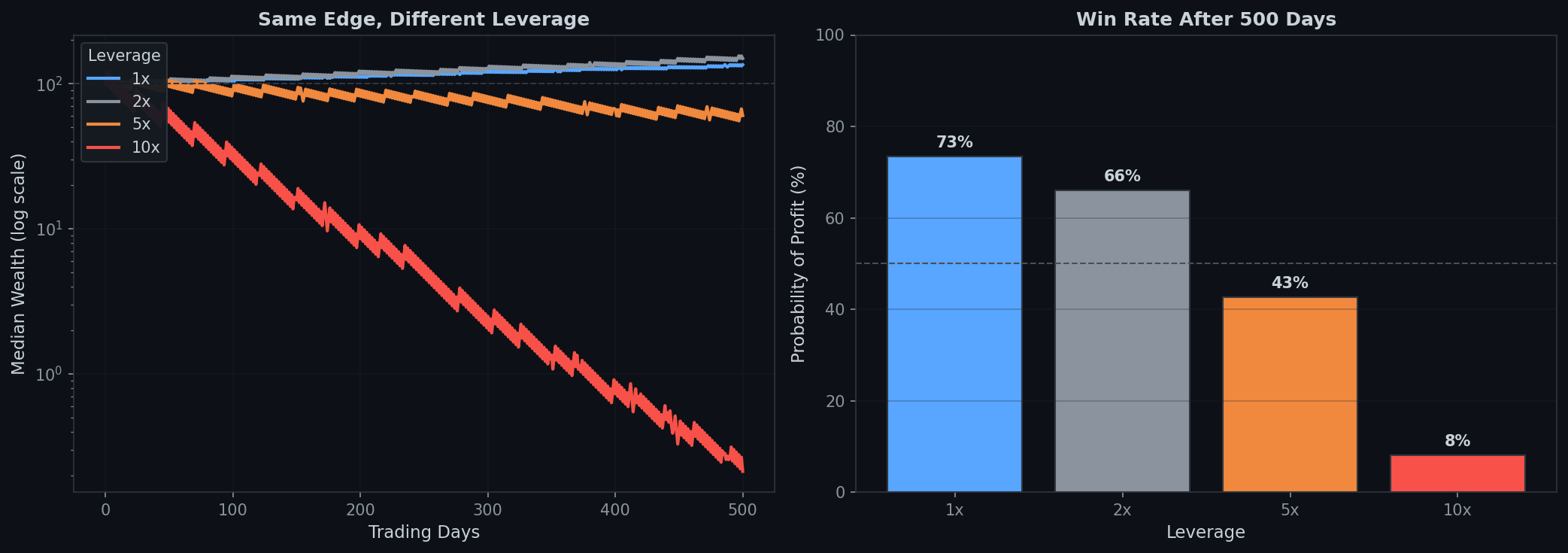
Overleveraging: You have a strategy with 60% accuracy. You know you have edge. So you lever up to maximize returns. But leverage amplifies the multiplicative nature of returns. What was a survivable strategy becomes a time bomb.
Same 52% edge, different leverage. At 1x you profit. At 10x you're almost guaranteed to lose - despite having genuine edge on every trade.
Same strategy. Same 52% edge. But watch what leverage does. At 1x, you're profitable. At 5x, most traders lose money despite having real edge. At 10x, you're almost guaranteed to blow up.
Leverage doesn't just amplify returns. It amplifies non-ergodicity.
Martingale and averaging down: "I'll double my position to recover faster." You're increasing your multiplicative exposure exactly when you should be reducing it. The math is brutal: a few losses in a row at increasing position size destroys everything.
Ignoring drawdowns: A 50% drawdown requires 100% gain to recover. A 75% drawdown requires 300%. This asymmetry is pure non-ergodicity. The path you take matters as much as where you end up.
Optimizing for expected value instead of expected growth: Every backtest that maximizes Sharpe ratio or total returns without considering the path is implicitly assuming ergodicity. Real trading is path-dependent. Drawdowns kill you before the "long run" arrives.
The Practical Survival Guide
So what do you actually do with this?
1. Think in log returns, not linear returns
When evaluating any trade or strategy, ask: what's the expected log return? If you can't go positive, you're playing a losing game regardless of what the "expected value" says.
For a simple bet with probability p of winning w% and probability (1−p) of losing l%:
E[log(1+r)]=p⋅log(1+w)+(1−p)⋅log(1−l)
This must be positive for long-term wealth growth.
2. Size positions using Kelly (or fractional Kelly)
Never ask "how much can I make?" Ask "what bet size maximizes my long-term compound growth?" These are different questions with different answers.
For a simple win/lose bet with probability p and payout b:
f∗=bp⋅b−(1−p)
Then bet 25-50% of this fraction to account for uncertainty in your edge estimates.
3. Respect the asymmetry of losses
Recovery from loss is harder than the loss itself:
10% loss: need 11% gain to recover
25% loss: need 33% gain to recover
50% loss: need 100% gain to recover
90% loss: need 900% gain to recover
This asymmetry isn't psychological - it's mathematical. Protect capital first.
4. Never bet everything
In a multiplicative world, betting everything means one loss destroys you forever. Even a 99% probability of success means a 1% chance of permanent elimination.
The Kelly Criterion automatically prevents this - it never recommends betting 100%.
5. Be skeptical of "long-run" arguments
"In the long run, this strategy wins." Maybe. But the long run might not arrive if short-term variance kills you first. The path matters. Survival is prerequisite to success.
The Uncomfortable Truth
Ergodicity economics isn't just academic theory. It's why:
Most traders lose money even with real edge
Leverage is more dangerous than it appears
Passive index investing beats most active strategies
The rich get richer (survival creates compounding)
Casino games feel "fair" while trading feels brutal
The expected value of your next trade doesn't determine your outcome. The compound growth rate of your sequence of trades does.
And those are not the same thing.
Ole Peters, the physicist who formalized much of this thinking, has spent decades showing how mainstream economics got this wrong. The assumption of ergodicity - that ensemble averages equal time averages - is embedded so deeply in economic theory that most practitioners don't
even know they're making it.
Now you do.
Next time someone shows you a positive expected value and tells you to bet big, remember the coin flip. Remember the 86% who went broke on a "winning" bet.
Then size your position accordingly.
This is what they don't teach in textbooks. For more insider quant insights, follow along at @mirkovicdev.
End of entry
Found this useful?
Likes decide what gets written next.Sign in to like
QuantFrame
Liked this article?
QuantFrame teaches you the math, code, and projects to break into quant. Plus a personalized roadmap built for your background and goals.